
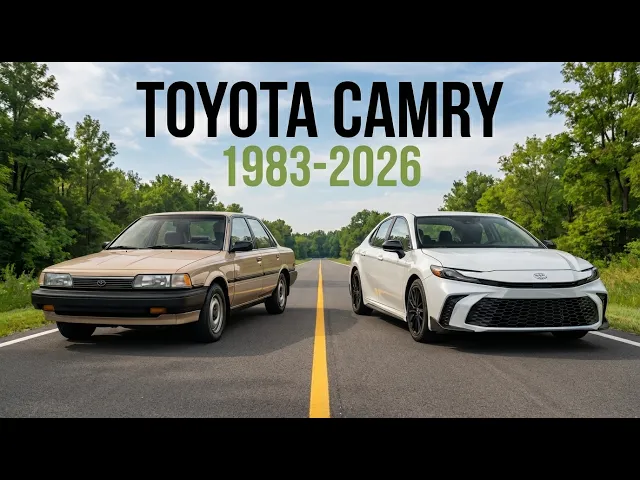
For over four decades, the Toyota Camry design evolution has served as a highly influential case study in global automotive styling, demonstrating how a simple commuter can morph into a cutting-edge icon.
- Practical Roots: Early generations prioritized functional utility with boxy silhouettes and robust packaging.
- The TNGA Shift: The eighth generation fundamentally reshaped the Camry’s attitude with low-slung, athletic proportions.
- The Future is Here: Modern generations utilize high-tech details like the Hammerhead front fascia and premium lighting elements.
The Early Era: Simplicity and the Pursuit of Aerodynamics
In the early 1980s, the first-generation Toyota Camry entered the world during an era where durability and practical packaging reigned supreme. Its exterior aesthetic was characterized by sharp vertical glass surfaces, conservative straight body lines, and upright rectangular headlights. This highly functional design maxim minimized engineering complexity while establishing an outstanding reputation for long-term build reliability. There were no emotional stylistic flourishes here; instead, it served as a trusted companion for families worldwide.
As the late 1980s rolled in, Toyota responded to tightening fuel-economy standards and emerging engineering wind tunnels with the second-generation Camry. The harsh rectangular edges began to soften. Curved panel corners, slimmer front headlights, and a gently integrated roofline marked the brand’s very first steps toward aerodynamic efficiency. The Camry was evolving from a basic tool into a sophisticated modern automobile.
The Golden Middle: Global Ambitions and Mature Aesthetics
With the launch of the third-generation Camry in the early 1990s, the vehicle took on its legendary wide-body proportions. Sculpted body panels, beautifully curved sheet metal, and a wide stance projected newfound confidence. By harmonizing global proportions across major international markets, Toyota transformed the sedan from a sensible commuter into an elegant midsize powerhouse.
This upscale momentum carried directly into the fourth and fifth generations as the millennium turned. While the fourth generation focused on a soft, comforting layout that established absolute consumer trust, the fifth generation shook up the formula with sharper geometric headlights and a bolder front grille structure. Toyota’s designers began artfully blending timeless family-car elegance with subtle athletic details, readying the sedan for a fast-changing marketplace.
The Athletic Turn: Sculpted Panels and the Sport-Minded Camry
The sixth and seventh generations marked a dramatic turning point in the model’s lineage. Toyota’s designers added expressive character lines, introducing angular headlight clusters and muscular bumper curves to combat the sedan’s historically conservative reputation. By the time the seventh-generation model debuted, designated sport packages like the SE and XSE variants brought heavy visual attitude with larger front grilles and aggressive blacked-out trims.
The eighth-generation Camry completely shattered any remaining stereotypes. Moving over to the advanced TNGA architecture allowed designers to lower the hoodline, widen the track, and build an aggressively low-slung, performance-oriented sedan. Dominated by highly intricate mesh grilles, thin LED headlight signatures, and dual exhaust tips, this generation ensured that the Camry was no longer a vehicle that blended into traffic.
The Hammerhead Era: Modern Hybrid Integration
Today, the newest generation represents the absolute peak of modern design. Anchored by the striking Hammerhead front fascia and continuous premium lighting signatures, it blends futuristic styling with absolute efficiency. Every crease in its high-strength steel body has been highly optimized to slash through the air, highlighting a hybrid-driven architecture that looks sophisticated, premium, and ready for tomorrow.
| Generation / Era | Design Focus & Key Elements |
|---|---|
| Gen 1 (Early 1980s) | Boxy, upright packaging; simple rectangular glass and body lines |
| Gen 3 (Early 1990s) | Wider global body; sculpted, curved side panels for elegant appeal |
| Gen 6 & 7 (2007-2017) | Introduction of angular grilles, sculpted front bumpers, and sport trims |
| Gen 8 (2018-2024) | Low-slung TNGA platform, massive aggressive grilles, and razor LED lights |
| Gen 9 (Present) | Sleek Hammerhead front layout, aerodynamic curves, and futuristic lighting |
- Incredible aesthetic journey from conservative lines to ultra-modern, athletic proportions.
- TNGA platform implementation allowed for genuinely premium stance and low-slung look.
- Newest Hammerhead front fascia gives it an upscale, premium-tier look.
- Early 1980s and late 1990s styling lacked the high-energy visual excitement of today’s models.
- Older versions prioritised family practicality so heavily that they looked highly conservative.
The visual history of the Toyota Camry proves that reliability doesn’t need to mean boring. From a boxy family workhorse to the razor-sharp Hammerhead hybrid of today, Toyota has written a masterclass in long-term styling evolution.
Frequently Asked Questions
What is the Hammerhead design on the newest Toyota Camry?
The Hammerhead design is Toyota’s modern signature front fascia. It features highly integrated, ultra-thin LED headlight signatures that wrap cleanly around a sharp, aerodynamic nose cone, giving the car a sophisticated premium-brand posture.
How did the TNGA platform change the Camry’s design?
The adoption of the TNGA architecture allowed engineers to lower the engine hood and the overall vehicle height. This gave designers the structural freedom to create a lower, wider, and significantly more aggressive stance that broke away from traditional tall-box family sedan styling.
| Key Vehicle Data | |
|---|---|
| Status / Type | Confirmed |
