
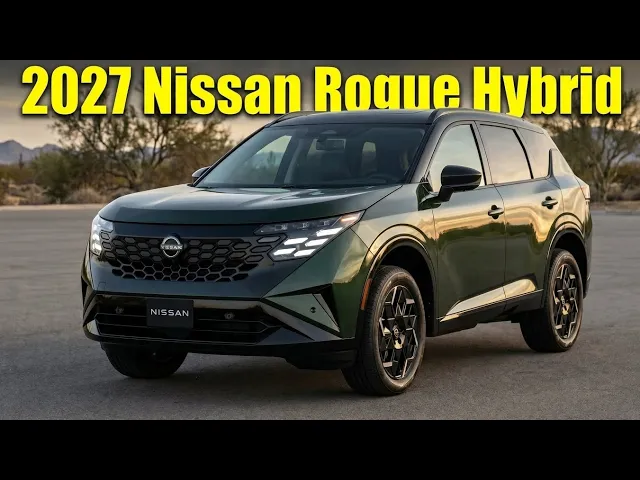
The 2027 Nissan Rogue Hybrid has officially arrived, marking what could be the most pivotal automotive launch for Nissan in North America in over a decade. After years of watching rivals command the lucrative compact hybrid crossover segment, Nissan is finally unleashing its highly sophisticated e-POWER technology on western shores. Rather than copying the traditional power-split hybrid blueprints popularized by Toyota and Honda, Nissan has engineered a radically different solution that promises the smooth, instantaneous driving dynamics of a battery-electric vehicle without any of the associated range anxiety.
- Third-generation e-POWER system drives the wheels exclusively via electric motors, eliminating the CVT entirely.
- The highly efficient 1.5-liter turbocharged engine serves strictly as an onboard generator.
- Innovative active body control and one-pedal driving modes bring genuine premium EV dynamics.
The e-POWER Philosophy: An EV with a Gasoline Generator
To understand why the 2027 Nissan Rogue Hybrid is generating such immense industry buzz, one must look beneath the hood. Unlike conventional hybrids where both a gasoline engine and an electric motor mechanical couple to turn the drive wheels, Nissan’s third-generation e-POWER architecture behaves as a series hybrid. The internal combustion engine—a highly advanced 1.5-liter turbocharged 3-cylinder unit—is completely isolated from the wheels. Its sole responsibility is to operate as an onboard generator, constantly keeping the small high-output battery pack topped up.
Because the gasoline engine never directly powers the wheels, the Rogue Hybrid delivers the linear power delivery and instant torque characteristic of a pure EV. Nissan engineers have optimized this dedicated generator to achieve an astonishing 42% thermal efficiency, representing a massive technological leap over standard internal combustion setups. This means you get the quiet, effortless acceleration of an electric car coupled with the seamless refueling convenience of a traditional gas station.
Refinement and Driving Dynamics: Banishing the CVT
During initial prototype testing, the contrast between the standard gas-powered Rogue and the new 2027 Nissan Rogue Hybrid was immediately apparent. While the standard model’s Continuously Variable Transmission (CVT) can feel sluggish and slow to respond under heavy throttle, the e-POWER system is remarkably quick and refined. Because there are no traditional gears or transmission belts to delay power delivery, throttle response is instantaneous. Nissan has also focused heavily on isolating cabin noise, addressing previous engineering hurdles with highway refinement. Thanks to a series of smart calibration updates, this third-generation system boasts a 15% increase in highway efficiency, making it perfectly tuned for fast-paced North American highways.
| Metric | 2027 Nissan Rogue Hybrid Details |
|---|---|
| Powertrain Type | Third-Gen e-POWER Series Hybrid |
| Generator Engine | 1.5L Turbocharged 3-Cylinder |
| Drive Method | 100% Electric Motor Driven |
| Thermal Efficiency | 42% |
| Highway Efficiency Gain | 15% Improvement over Gen-2 |
| Special Features | One-Pedal Drive & Active Motion Control |
EV Tech for the Hybrid Class: One-Pedal Driving and Flat Cornering
In another nod to its electric siblings, the 2027 Nissan Rogue Hybrid introduces a highly intuitive one-pedal driving mode. When activated, lifting your foot off the accelerator deploys strong regenerative braking, smoothly slowing the crossover to a complete halt without requiring you to touch the brake pedal. This system is exceptionally smooth and intuitive, making daily city commutes far more relaxing. Furthermore, Nissan has leveraged the rapid response of the electric motors to enhance ride quality. By applying precise counter-torque forces in milliseconds during deceleration, the Rogue’s electronic brain actively mitigates nose dive, keeping the body flat and preventing cabin pitch during spirited driving.
- Instantaneous electric torque with zero transmission lag.
- Exceptional body control that drastically reduces braking nose dive.
- Intuitive one-pedal driving mode elevates urban commuting.
- Engine noise can occasionally feel disconnected from acceleration.
- Regenerative braking is slightly milder than a full EV.
The 2027 Nissan Rogue Hybrid represents a brilliant mechanical bridge, merging the instant torque and refined quietness of an EV with the absolute range security of gasoline power.
Frequently Asked Questions
How does the e-POWER system work in the 2027 Nissan Rogue Hybrid?
Unlike traditional hybrids, the wheels of the 2027 Nissan Rogue Hybrid are driven entirely by electric motors. The onboard 1.5-liter turbocharged engine functions solely as a high-efficiency generator to charge the battery and power the motors.
Does the Rogue Hybrid have a CVT transmission?
No, the Rogue Hybrid does not use a CVT or any traditional transmission. Because the wheels are turned purely by electric motors, it features a direct, single-speed power delivery system identical to a full battery-electric vehicle.
What is the advantage of active body control on this model?
Nissan utilizes the millisecond response times of the electric drive motor to apply counter-torque when braking. This significantly reduces front-end nose dive, keeping the chassis flat and ensuring a more premium ride experience.
| Key Vehicle Data | |
|---|---|
| Status / Type | Rumored |
