
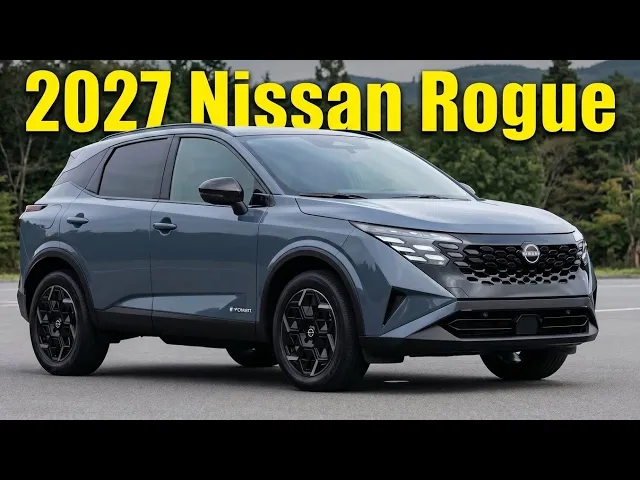
The 2027 Nissan Rogue has officially been previewed, signaling one of the most significant compact SUV transformations of the decade. Unveiled during the high-profile Nissan Vision event, this next-generation model does not merely represent a cosmetic refresh. Instead, it ushers in a monumental shift in how Nissan Motor Corporation plans to deploy electrification across its core lineup. With over 10 million units sold globally since its inception in 2000, the Rogue—known globally as the Nissan X-Trail—is the ultimate volume-driver for the brand. For 2027, Nissan is leveraging this massive footprint to introduce a revolutionary powertrain that bridges the gap between traditional combustion and full battery-electric vehicles.
- Dual-motor e-Power hybrid system where the gas engine acts strictly as a generator.
- EV-like driving experience with instant torque and near-silent operation without a charging plug.
- Advanced Mobility Intelligence integration featuring AI-driven vehicle systems and premium interior tech.
The Magic of e-Power Technology
Unlike traditional hybrid setups found in rivals like the Toyota RAV4 Hybrid or Honda CR-V Hybrid, the upcoming 2027 Nissan Rogue utilizes a highly unique series-hybrid architecture. In this system, a gasoline engine is nestled under the hood, but it has zero physical connection to the driven wheels. Instead, the engine serves exclusively as an onboard electricity generator. This energy is fed directly to dual high-output electric motors, which are solely responsible for propelling the SUV.
This setup offers a stark alternative to conventional power-split hybrids. Drivers will experience the hallmark traits of an electric vehicle—namely instant torque delivery, seamless linear acceleration, and near-silent operation—without the associated range anxiety. Nissan has already proven this concept in international markets, having delivered nearly 2 million e-Power vehicles globally since 2016. By bringing this technology to the North American market, the brand aims to completely disrupt the compact hybrid crossover hierarchy.
Bridging the Gap: Performance Without Range Anxiety
For buyers hesitant to make the leap to full battery-electric vehicles due to lackluster public charging infrastructure, the 2027 Nissan Rogue Hybrid serves as an ideal stepping stone. Because the vehicle relies on standard gasoline to fuel its onboard generator, there is absolutely no need to plug it in. You get the benefit of rapid fuel stops combined with the refined, low-vibration driving dynamics typically reserved for pure EVs.
Expect a highly responsive drive, particularly in stop-and-go city traffic where low-speed torque is vital. On the highway, the dual-motor setup promises confident passing power and balanced all-wheel-drive traction. It represents a highly practical solution for families, daily commuters, and long-distance road trippers who want to cut down on fuel bills without altering their driving habits.
| Metric | Details / Spec |
|---|---|
| Powertrain | e-Power Series Hybrid (Dual Electric Motors) |
| Engine Function | Dedicated Generator (No Direct Wheel Drive) |
| Global Tech Validation | Nearly 2 Million e-Power Units Sold Since 2016 |
| Core Concept | Mobility Intelligence & Flexible Electrification |
| Target Market Focus | EV Dynamics with Zero Range Anxiety |
Mobility Intelligence and a Futuristic Design
The 2027 Nissan Rogue is not just a hardware upgrade; it is also a flagship for Nissan’s broader Mobility Intelligence for Everyday Life initiative. This corporate strategy centers on creating software-defined vehicles that are smarter, more connected, and highly adaptable to individual driver behaviors.
While official, detailed images remain under wraps, the preview suggests a striking, highly aerodynamic exterior layout that signals its advanced powertrain. Inside, buyers should anticipate a massive leap in interior refinement. We expect to see larger digital displays, next-generation infotainment, advanced semi-autonomous driver assistance systems, and AI-driven features designed to optimize route planning and energy efficiency in real-time.
- True EV-like driving characteristics with instant torque and smooth acceleration.
- Zero range anxiety and absolutely no charging infrastructure required.
- Proven global technology with millions of miles already driven.
- Fuel efficiency might vary at sustained high-speed highway cruising.
- Potential price premium over standard internal combustion Rogue models.
The Ultimate Verdict
With the compact SUV segment becoming increasingly competitive, Nissan’s choice to bring e-Power to North America with this redesigned model is both bold and calculated. If the automaker can price this model competitively against established hybrid giants, it is highly likely to redefine the segment.
The 2027 Nissan Rogue Hybrid represents a brilliant compromise for the modern era, marrying the seamless power of an electric motor with the fuss-free utility of gasoline.
Frequently Asked Questions
What is Nissan e-Power technology?
Nissan’s e-Power is a series-hybrid system where a gasoline engine acts purely as an onboard generator to produce electricity, while high-output electric motors solely drive the wheels. This delivers an EV-like driving experience without needing to plug in the vehicle.
Does the 2027 Nissan Rogue need to be plugged in?
No, the 2027 Nissan Rogue Hybrid does not require plug-in charging. You simply fill it up with gasoline like a conventional vehicle, and the onboard generator creates the electricity required to power the drive motors.
How does e-Power compare to traditional hybrids from Toyota and Honda?
Traditional hybrids use both the gasoline engine and electric motor to physically turn the wheels. Nissan’s e-Power keeps the gasoline engine completely decoupled from the drivetrain, resulting in smoother, more responsive, and quieter EV-style acceleration.
| Key Vehicle Data | |
|---|---|
| Status / Type | Confirmed |
