
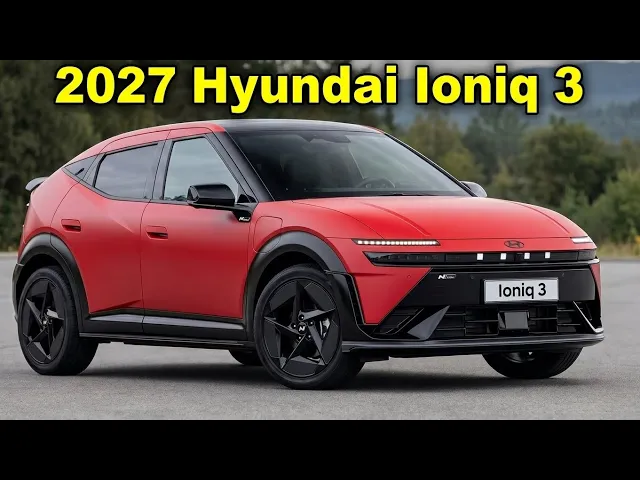
What if the future of electric mobility wasn’t a luxury reserved for the few, but an attainable, stylish reality for everyone? The newly revealed 2027 Hyundai Ioniq 3 represents the South Korean brand’s most ambitious attempt yet to democratize premium EV technology. Positioned as an affordable, high-tech compact hatchback, this vehicle aims to challenge established EV giants while undercutting them significantly on price.
- Stunning Aero Hatch Styling: Concept-car looks with an impressive 0.26 drag coefficient and signature pixel LED lighting inspired by the larger Ioniq 5.
- Surprisingly Spacious Interior: Featuring a highly practical “furnished space” layout, a completely flat floor, and a class-leading 441-liter boot capacity.
- Premium Tech at an Entry-Level Price: Standard 12.9-inch or optional 14.6-inch displays running on Android Automotive OS, alongside V2L capability and Highway Driving Assist 2.
A Futuristic “Aero Hatch” Inspired by Heritage
Hyundai’s design language has been on a winning streak, and the 2027 Hyundai Ioniq 3 continues this trajectory. Defined by what the company calls an “aero hatch” silhouette, the car boasts a sweeping front fascia and an aerodynamic, sloping roofline. This isn’t just for aesthetics; it helps the hatchback achieve an exceptional drag coefficient of 0.26 Cd, maximizing every kilowatt-hour of battery energy.
Up front, the signature pixel LED headlights create an unmistakable presence on the road. From the profile, automotive enthusiasts will catch glimpses of a modern, matured Hyundai Veloster—cleaner, wider, and far more sophisticated. Hyundai is clearly targeting younger buyers and first-time EV owners who demand standout styling without paying a premium tax.
The “Furnished Space” Cabin Concept
Step inside, and the layout defies the compact footprint of the car’s 4.1-meter overall length. Leveraging a dedicated electric global modular architecture, the 2027 Hyundai Ioniq 3 features a generous 2.68-meter wheelbase. With no transmission tunnel, the completely flat floor translates into immense legroom and passenger comfort that punches far above its weight class.
Hyundai describes the interior philosophy as a “furnished space,” striving to evoke the cozy, minimalist ambiance of a modern living room. Despite its compact exterior dimensions, cargo capacity is not compromised, offering a class-leading 441 liters of boot space to easily swallow luggage, groceries, or weekend gear.
| Metric | Details / Spec |
|---|---|
| Engine/Layout | Single Motor, Front-Wheel Drive (FWD) |
| Horsepower | 135 – 147 hp (101 – 110 kW) |
| 0-100 km/h (0-62 mph) | ~9.0 seconds |
| Wheelbase | 2.68 meters |
| Boot Capacity | 441 Liters |
| Drag Coefficient | 0.26 Cd |
Urban-Focused Performance and Commuter Efficiency
While the Ioniq 5 and Ioniq 6 offer blistering dual-motor acceleration, the 2027 Hyundai Ioniq 3 takes a more pragmatic path. Power is delivered exclusively via a single-motor, front-wheel-drive setup generating between 135 and 147 horsepower. The sprint from 0 to 100 km/h takes roughly 9 seconds.
This modest output is a deliberate choice. The Ioniq 3 is engineered as an efficient, smart city commuter rather than a high-performance track weapon. It prioritizes daily usability, lower insurance premiums, and maximized urban driving range—delivering exactly what the everyday driver actually needs.
Flagship Technology in an Entry-Level Package
Where the Ioniq 3 truly disrupts the segment is its technological loadout. The cabin is dominated by a standard 12.9-inch touchscreen, which can be upgraded to an expansive 14.6-inch display. Running on Hyundai’s latest Pleos Connect infotainment ecosystem integrated with Android Automotive OS, the interface is exceptionally smooth. Crucially, tactile physical buttons remain for vital climate and audio controls, a major win for real-world ergonomics.
Furthermore, the hatchback inherits top-tier features from its larger siblings. This includes Vehicle-to-Load (V2L) capability to power external devices, a digital key for smartphone-only access, Highway Driving Assist 2 (HDA 2) for semi-autonomous cruising, and Remote Smart Parking. This is cutting-edge tech packaged into an affordable segment.
- Futuristic “Aero Hatch” design with distinctive Veloster vibes and pixel LEDs.
- Class-leading 441-liter boot space and flat-floor passenger comfort.
- Retention of physical control buttons alongside large, responsive screens.
- High-end features like V2L and Highway Driving Assist 2 in a budget car.
- Slower 0-100 km/h acceleration (~9 seconds) might disappoint enthusiasts.
- Front-wheel drive only layout limits sporty handling dynamics.
The 2027 Hyundai Ioniq 3 is a testament to clever engineering. By focusing on exceptional aerodynamics, high cabin usability, and democratic pricing rather than unnecessary straight-line speed, Hyundai has crafted the ultimate everyday electric car.
Frequently Asked Questions
What is the estimated cargo space of the 2027 Hyundai Ioniq 3?
The 2027 Hyundai Ioniq 3 offers an impressive, class-leading boot capacity of approximately 441 liters, made even more usable by the vehicle’s flat-floor electric platform.
What is the horsepower rating of the Hyundai Ioniq 3?
The urban-focused hatchback is equipped with a single electric motor powering the front wheels, producing between 135 and 147 horsepower (101 to 110 kW).
Does the Ioniq 3 support vehicle-to-load (V2L) technology?
Yes, the Ioniq 3 inherits Hyundai’s signature Vehicle-to-Load (V2L) capability, allowing owners to plug in and power external electrical devices directly from the car’s battery.
| Key Vehicle Data | |
|---|---|
| Status / Type | Confirmed |
